Data Visualization
Global Dynamics of Student Mobility
This globe illustrates the shifting landscape of international tertiary education. Each arc represents a corridor of human movement, tracking the seven million students moving across borders annually. This global flow supports academic careers, institutional operations, and the life choices of young people.
Active corridors
How to interact
Data sources
UNESCO Institute for Statistics (UIS) · IIE Project Atlas · NASA Blue Marble & Earth at Night imagery
Societās Partnerships · Working Paper · May 2026
Two Internationalizations
Closing the Credibility Gap in University Internationalization
A Stewardship Architecture for Hybrid International Portfolios
Carlos Vargas
Founder, Societās Partnerships · Panama
Working Paper · May 2026
Download the full working paper as PDF
Includes references, figures, and the architecture metrics table.
Executive Summary
The internationalization of higher education has lost the ability to describe accurately the value it produces. Visa caps in Canada, dependent restrictions in the United Kingdom, tightened immigration settings in Australia, and intensified visa vetting in the United States have, between 2024 and 2025, exposed a credibility deficit the field had been building for at least a decade. The deficit is not principally a communications failure. It is a typology problem with a hybridity problem layered on top of it, both concealed by a public-communications apparatus that the field built deliberately and operated successfully until quite recently.
The field uses one word — internationalization — to describe at least three structurally distinct phenomena, each operated under a different political economy and each requiring a different evidence base. The Revenue Configuration, dominant in liberal-market economies, treats international tuition as the structural shock-absorber of higher-education finance. The Formation Configuration, dominant in continental Europe and parts of state-funded East Asia, operates internationalization as a humanistic and pedagogical project. The Capacity Configuration, dominant across Latin America, much of Africa, and much of Asia, treats internationalization as a means of institutional and national capacity-building. Each is internally coherent; none is a degraded form of the others. Most institutions, however, run portfolios across all three and have no usable architecture for honestly reporting hybrid operations.
The paper’s central proposal is the Stewardship Architecture: a governance and communication framework under which an institution running activities across all three modes can account for each on its own terms. Five principles define it. Mode declaration: every activity is identified as primarily Revenue, Formation, or Capacity. Mode-appropriate evidence: each is reported against metrics native to its mode. Bargain naming: every cross-mode partnership documents what each side seeks and contributes. Portfolio reporting: institutional reporting presents the three modes side by side. Stakeholder calibration: each audience sees the mode most relevant to its decision rights. The architecture requires no capital expenditure, no legislative change, and no abandonment of existing programs. It requires the willingness to admit that one institution is running a portfolio that the field has been instructed to describe as a single phenomenon.
Author’s Note
This paper is built from the published literature, but the literature itself appears to lack system-level information of the kind required to analyze large-scale changes in a sector as structurally varied as global higher education. The bulk of the field’s published work consists of single-institution case studies, regional analyses, and topic-specific studies — mobility, partnership management, branch campuses, intercultural assessment — and does not, in general, attempt to characterize the sector as a system of structurally distinct configurations operating under different political economies. To address that gap, the analysis here is supported by experience drawn locally from work in Canadian higher education and internationally from many years of repeated engagement with partner institutions across multiple regions. Where the published literature is cited, it is cited; where the argument runs ahead of what the literature has formally established — particularly in the typology of three configurations and in the diagnosis of what the credibility deficit costs the sector — the paper draws on patterns observed across institutions, and those patterns should be read as practitioner inference rather than as findings derived from a formal study. The positioning is offered for transparency: the argument is intended to be useful to senior leadership now; it does not substitute for the system-level empirical work that the field still needs, and that the Stewardship Architecture, if adopted, would help to produce.
Epilogue
About the Arcs
The globe on the cover includes arcs which are not decorative. Each one represents a corridor of human movement that a national statistical agency, a university registrar, a visa officer, and a family somewhere in the world have all separately recorded. It represents over seven million students moving across borders for tertiary study in a given year (Gutović et al., 2026). That is the population of a mid-sized country, distributed across thousands of campuses, supporting hundreds of thousands of academic relationships and a financial system worth more than a hundred billion dollars in tuition alone. Global higher education supports the careers of millions of academics, the operations of countless universities, and the life choices of young people.
Even where individual flows look small on the map — the corridor between two mid-sized regional universities, the cohort of fifty doctoral students returning each year to a Latin American or African flagship, the half-dozen Erasmus-funded partnerships that constitute a small institution’s entire international footprint — the impact at the level of the institution and of the people involved is not small. Internationalization is one of the few activities in which the modern university routinely transforms the life of someone outside its own walls.
The enormity of such an enterprise, as complex and impactful as it is, has lost the words to describe itself accurately to those outside the academy, and that absence of accurate language produces a credibility crisis that threatens the work itself. This paper is not a critique of internationalization. It is a defense of internationalization, made by insisting that each component of it be reported on against the evidence native to that component. The institutions whose work is reflected in those arcs deserve the discipline.
Section 1
1. Introduction
Two internationalizations now operate inside every research-active university. The first is the synthesized internationalization that appears in strategic plans, vice-chancellors’ speeches, press releases, and recruitment brochures — a single integrated story about global engagement. The second is the operational internationalization the institution actually runs, which on inspection turns out to be three structurally distinct phenomena, each operated under a different political economy and requiring a different evidence base. The credibility crisis lives in the distance between the two: a public account that promises one thing and an operational reality that delivers another, with the gap concealed by a vocabulary that the field built deliberately and operated successfully until quite recently. No institutional report on internationalization can presently tell its readers, with the precision other parts of the university routinely demonstrate, what is being claimed and on what evidence.
The diagnosis is direct rather than critical. The institutions that built the synthesized account are not bad actors; they responded rationally to incentives that worked for fifteen years and have, in the last twenty-four months, ceased to work. The recommendations are correspondingly direct: not to abandon what institutions do, but to describe what they do in language that survives external scrutiny. The configurations are three; the internationalizations are two.
Section 2
2. The Catchall Term
The higher-education sector has actively hollowed out the concept of internationalization, transforming it into a nebulous term institutions deploy to claim any favorable position. The most influential definition in the field — Jane Knight’s framing of internationalization as the process of integrating an international, intercultural, or global dimension into post-secondary education (Knight, 2003) — is broad by design, and the breadth has been an enabling condition for its diffusion. In strategic plans, annual reports, vice-chancellors’ speeches, press releases, recruitment marketing, and social-media announcements, the same word covers tuition recruitment, study abroad, branch campuses, capacity-building partnerships, joint research, and curriculum integration. Its conceptual ambiguity is an open ticket for any university to self-invite as an internationally oriented institution.
The absence of rigorous pedagogical assessment, complex student learning outcomes, or genuine intercultural-competence measurement in public accounting is filled with output indicators — number of mobile students, signed institutional agreements, and the economic impact generated by foreign enrolees (Deardorff & van Gaalen, 2012; Buckner & Stein, 2020). While such numbers tell a real story, they do not commit the institution to long-term transformational improvement. The reliance on volume metrics creates a quantitative illusion: an administrative shield that allows universities to broadcast an image of global integration while remaining structurally oblivious to the developmental value they produce.
The illusion is compounded by global university rankings, which weight institutional research output and reputation while treating teaching quality and social contribution as residuals (Hazelkorn, 2015; Marginson, 2026). Rankings allocate prestige based on the proportion of international students and staff, formally rewarding raw enrollment volume as a proxy for academic quality. Because institutions prioritize these external validations over internal pedagogical missions, the value of international higher education becomes subordinated to the competitive metrics of a manufactured global market.
Section 3
3. Structural Background
The current configuration of internationalization is not the product of a single decision. The Revenue Configuration emerged from the neoliberal restructuring of higher-education finance in Anglo-American economies from the 1980s onwards (Marginson, 2007; Slaughter & Rhoades, 2004). The Formation Configuration emerged from the post-war humanistic mandate of European universities, formalized in the Bologna Process and updated through the 2015 European Parliament redefinition (de Wit et al., 2015). The Capacity Configuration has older roots in the postcolonial period and the bilateral and multilateral development funding architecture of the late twentieth century, more recently consolidated through regional university networks, South–South cooperation, and national research-funding councils across the Global South (Teferra & Knight, 2008; Heitor, Horta & Salmi, 2016). None of these trajectories was designed to coexist with the others under a single conceptual heading; they accreted under one heading by historical accident.
The 2020–2022 pandemic exposed the fragility of the synthesized model. Institutions that had assumed perpetual growth in international tuition, frictionless mobility, and stable bilateral research access found all three suspended at once and were forced to confront, often for the first time, that their three configurations were operationally distinct and required separate adaptive responses (Huang, Crăciun & de Wit, 2022). The post-pandemic recovery did not return the system to its pre-2020 logic; it accelerated structural pressures that had been building for a decade. The 2018–2025 period added two further pressures: the securitization of research collaboration in the Five Eyes nations and the European Union, and the political backlash against migration that has reshaped the regulatory environment for international students in the four largest receiving countries.
The configurations themselves cannot be redesigned by institutional fiat. A vice-chancellor cannot, on her own authority, alter the visa regime, the domestic fee cap, the bilateral development budget, or the migration politics of her host country. What she can redesign is the description, accounting, and communication of the activities the institution already operates. The intent of this paper is to make that level of reform legible and actionable; it does not claim that governance reform substitutes for political reform.
The postcolonial critique of internationalization, growing through the 2010s and 2020s, identifies that the existing configurations were constructed in patterns of asymmetric exchange and that partnerships across them frequently reproduce those asymmetries (Stein, 2021; Buckner & Stein, 2020). No governance framework alone resolves that critique. The framework proposed here provides a mechanism by which the asymmetries can be named, tracked, and contested. Visibility is a precondition for redress.
Section 4
4. Three Operational Configurations
Internationalization is dominated by three configurations, each internally coherent. A particular financial logic produces a particular set of stakeholders, who require a particular evidence base, against which the institution reports particular metrics. Each is also politically vulnerable in a different way, and each suffers a characteristic evidentiary failure when its language is borrowed by an institution operating principally under a different configuration.
4.1 The Revenue Configuration
The Revenue Configuration is found principally in Anglo-American liberal-market economies — the United States, the United Kingdom, Canada, Australia, and New Zealand — and in a few Asian systems with similar tuition-driven structures. Its defining feature is that international tuition functions as the structural shock-absorber of higher-education finance. The literature names adjacent versions of this phenomenon as academic capitalism (Slaughter & Rhoades, 2004), the marketization of higher education (Marginson, 2007), and education as export industry in Australian and UK policy framings; this paper treats Revenue as the configuration in which international tuition recruitment becomes the structural condition of solvency rather than a complementary income stream. International fee income at UK higher-education providers reached approximately £11.8 billion in 2022/23, representing 23 percent of total UK sector income (HESA, 2024; House of Commons Library, 2024). For England specifically, international fees produced approximately £9.4 billion that year, around 20 percent of sector income (Tony Blair Institute, 2025). Comparable dependencies exist in Australia, Canada, the United States, and New Zealand. Continental European systems have not generally developed this configuration to the same depth, though Sweden, Denmark, Finland, and Norway have introduced fees for non-EU students over the past decade and a half (Mulvey, 2025).
Revenue mode is also no longer a strictly Anglo-American phenomenon. Several middle-income systems have built localized Revenue models to offset domestic underfunding: Malaysia and the United Arab Emirates host transnational hubs with branch campuses and regional fee-paying intakes; the Gulf states more broadly operate sovereign-financed branch ecosystems that combine Revenue and Capacity logics in a configuration the existing literature has not fully theorized; and a number of Latin American and Southern African flagships now run fee-paying English-medium master’s programs for students from neighboring countries. The 2024–2025 contraction in the Anglo-American core is likely to accelerate these intra-regional corridors, as recruitment that no longer flows easily to traditional destinations seeks intermediate ones, and as middle-income systems read the fiscal arithmetic of the high-income receivers and act on it. The configuration is therefore best understood as Anglo-American by origin and center of gravity but no longer by exclusive geography. The argument that follows treats the Anglo-American case as the paradigmatic Revenue site because the empirical literature is most developed there; the framework, however, applies wherever international tuition functions as a structural shock-absorber of institutional finance.
Within the Revenue Configuration, three sub-modes carry different credibility risks. The first is high-tuition, low-support recruitment — the predominant UK master’s pattern, in which substantial international fees fund institutional operations against limited additional pedagogical scaffolding. The second is medium-tuition, integrated recruitment — the Australian and parts of the Canadian pattern, in which fees are lower per head, student-support infrastructure is more substantial, and post-study work pathways are explicit components of the offer. The third is transnational education — branch campuses, franchised programs, and joint ventures delivered in the source country or a regional hub, in which fees are typically lower than onshore equivalents and operational risk is shared with a local partner. The first is most exposed to the charge that recruitment volume is doing the work pedagogy is being credited for; the second is most defensible under migration scrutiny because the post-study commitment is named and resourced; the third stands or falls on local regulatory accommodation and the operational competence of the in-country partner. Mode declaration therefore disaggregates Revenue activities accordingly rather than treating the configuration as monolithic.
The configuration’s expansion is driven by a demographic alignment rarely named in institutional reporting. High-income economies face projected labor-force contractions sufficient that several have re-engineered their post-study work routes to retain international graduates as skilled labor (Altbach, Reisberg & Rumbley, 2009; OECD, 2025), while expansion of secondary and tertiary participation in Asia, Africa, and parts of Latin America has produced cohorts willing to deploy private family capital for international credentials (British Council, 2024). The financial logic depends on this alignment holding; when receiving-country migration politics or sending-country currency conditions move, the configuration is correspondingly exposed. The reinforcing mechanism is the rankings system, which treats Revenue-mode volume as a proxy for institutional quality (Marginson, 2026).
The configuration answers to the board, the finance ministry, and the immigration department, and operates under the disciplining pressure of the global rankings. Success is measured in fee revenue, enrollment volume, employability, and post-study work uptake. Political vulnerability includes domestic backlash against migration, currency volatility, geopolitical disruption of source markets, and tightening of post-study work routes — all of which materialized between 2024 and 2025.
The characteristic evidentiary failure of the Revenue Configuration is the practice of claiming Formation outcomes — intercultural competence, global citizenship — in defense of a system that operationally is a credentials business. A senior administrator who states that the institution’s 35 percent international student share confirms its commitment to global citizenship is making this error. The recruitment metric is Revenue; the outcome claim is Formation; and the empirical literature does not support the inference that the first produces the second without deliberate pedagogical engineering (Harrison, 2015; Deardorff & van Gaalen, 2012).
4.2 The Formation Configuration
The Formation Configuration is found principally in continental European state-funded systems, the Nordics, and parts of state-funded East Asia, including Japan and South Korea. Its defining feature is that international engagement is operated as a pedagogical and humanistic project. The literature names adjacent versions of this orientation as comprehensive internationalization (Hudzik, 2011), internationalization at home (Beelen & Jones, 2015), and internationalization for society in the European Parliament study (de Wit, Hunter, Howard & Egron-Polak, 2015); intercultural-competence assessment (Deardorff, 2006) provides its evidence base. The 2015 European Parliament redefinition — the intentional process of integrating an international, intercultural or global dimension into the purpose, functions and delivery of post-secondary education, in order to enhance the quality of education and research for all students and staff, and to make a meaningful contribution to society (de Wit, Hunter, Howard & Egron-Polak, 2015) — is the authoritative statement of this configuration’s rationale. A subsequent literature has aligned it with the United Nations Sustainable Development Goals (Ramaswamy et al., 2021).
The stakeholders are the ministry of education or research, the European Commission for institutions inside the EU, accreditation bodies, faculty governance, and a public that expects higher education to function as a public good. Success is measured in pedagogical outcomes — intercultural competence, language acquisition, civic disposition — alongside research collaboration quality and graduate readiness. The evidence base requires outcome-assessment instruments (Deardorff, 2006), participation rates across the student body, graduate dispositional surveys, and bibliometrics.
The conditions that produce measurable gains in intercultural competence are well established. Genuine intercultural competence does not emerge from mere exposure to diversity; it must be deliberately developed across cognitive, affective, and behavioral domains and assessed with multi-perspective tools (Deardorff, 2006). Without explicit pedagogical scaffolding, domestic students have been observed to resist intercultural group work and avoid contact with international peers, defaulting to what Harrison and Peacock (2010) characterized as passive xenophobia — avoidance and silence around cultural difference rather than the engagement institutional rhetoric implied. Comparable patterns have been documented in Australian and Korean settings (Volet & Ang, 2012; Jon, 2013); the broader inference — that mere proximity does not produce intercultural competence absent intentional design — is consistent across the literature. An activity reported as Formation that lacks the design features (assessed group work across cultural lines, structured intercultural-competence instruction, faculty preparation) is, in operational terms, not a Formation activity.
The characteristic evidentiary failure of the Formation Configuration is the practice of treating exposure as evidence of outcome. The pro-vice-chancellor who reports that eighty-five percent of our students took at least one course with international content this year is reporting on content delivery, not on intercultural development. The first is easy to count; the second requires assessment infrastructure that few institutions yet maintain. The same pattern appears when virtual-exchange enrollment is offered as evidence of intercultural learning, when destination diversity of an Erasmus cohort substitutes for evidence about learning outcomes, or when the count of internationally-themed events is treated as a measure of formation. These are participation metrics; they describe the conditions under which formation might occur, but not whether it did. Mobility itself reaches only between two and three percent of the world’s tertiary students (UIS, 2024) and is socioeconomically selective even within that minority (Granato & Schnepf, 2024). Internationalization at home (Beelen & Jones, 2015) is the field’s response, but its assessment regime is uneven.
The asymmetry between Formation’s measurement difficulty and the relative ease of counting Revenue and Capacity outputs creates a known reporting hazard for any portfolio framework: an institution that disciplines itself to mode-appropriate evidence will systematically under-report Formation simply because the validated outcome instruments are scarce, expensive, and unevenly implemented. The conservative response is process metrics where outcome metrics are unavailable. An activity reported as Formation should at minimum document the design features the literature identifies as preconditions of intercultural development: assessed group work across cultural lines, structured intercultural-competence instruction, faculty preparation in intercultural pedagogy, and integration of international content into the formal curriculum (Deardorff, 2006; Beelen & Jones, 2015). Process metrics are not a substitute for outcome assessment, and the architecture should not pretend they are; they are the honest interim, sustained until outcome instruments mature, that prevents Formation from being silently squeezed out of the portfolio by what is easier to measure.
4.3 The Capacity Configuration
The Capacity Configuration is found principally in state-funded systems across Latin America, most of Africa, and much of Asia. Its defining feature is that internationalization is operated as a means to acquire research infrastructure, faculty training, access to global knowledge networks, and graduate placement abroad — capacity the domestic system does not yet sustain at the required scale. The literature names adjacent versions of this configuration as capacity-building internationalization (Teferra & Knight, 2008), internationalization for development in the Latin American comparative analyses (de Wit, Jaramillo, Gacel-Ávila & Knight, 2005; Gacel-Ávila, 2007), and South–South cooperation in the regional research-network literature; the postcolonial critique of internationalization (Stein, 2021; Buckner & Stein, 2020) addresses the asymmetries that arise when this configuration partners with Revenue or Formation actors. Universities in this configuration are deeply embedded in their national regulatory frameworks and constrained by local realities of wealth, language, and policy in ways that institutions operating principally under the other two are not (Altbach, Reisberg & Rumbley, 2009). Although it is the dominant operating mode for the majority of universities in the majority of national systems, it is comparatively under-represented in the most-cited journals and policy literature of the field, which are largely produced from Anglo-American or European vantage points; the regional literatures cited below are correspondingly less integrated into the field’s synthesized account.
The configuration’s intellectual roots are well-documented in regional literatures. The foundational comparative analysis for Latin America (de Wit, Jaramillo, Gacel-Ávila & Knight, 2005) established that internationalization in the region had emerged predominantly as a capacity-building project; subsequent analyses have refined the framing (Gacel-Ávila, 2007; Heitor, Horta & Salmi, 2016). The parallel African analysis was consolidated by Teferra and Knight (2008), with Mohamedbhai (2014) arguing that African institutions need to contextualize internationalization to local realities rather than adopt Anglo-American or European models (see also Tamrat & Teferra, 2018; Teferra, 2014). The Asian literature documents a comparable configuration, particularly in Southeast Asia, where faculty doctoral training abroad and joint research collaboration — often funded through Official Development Assistance and bilateral arrangements with Japan, Australia, and continental European partners — are the principal mechanisms by which institutions in Indonesia, Vietnam, Cambodia, and parts of South Asia build domestic research capacity (Yonezawa & Yamamoto, 2024).
The stakeholders are the ministry of education or science, the national funding council, the rector, faculty leadership in priority disciplines, and partner governments where bilateral agreements are involved. Success is measured in governance performance, co-authored publications, doctoral placements abroad with documented return, faculty receiving advanced research training, equipment access via partnership, and joint grant capture. Political vulnerability includes brain drain when graduates do not return, donor-driven priorities that distort the research agenda, and the systematic asymmetry of partnerships with institutions operating principally under Revenue or Formation logics. The configuration’s uneasy relationship with the rankings system is structural; rankings allocate prestige using metrics native to the Revenue and Formation configurations. Some Capacity-mode institutions have responded by pursuing ranking improvements at the cost of their actual capacity-development goals. Others have explicitly rejected the metrics as inappropriate to their contexts (Teferra, 2014). Either response carries costs.
The metrics native to the Capacity Configuration carry a structural risk. Co-authored publications in indexed venues and doctoral placements abroad with documented return are useful indicators, but they are also indicators defined within the Northern academic system, and used alone they quietly redefine Southern capacity in Northern terms. A robust Capacity reporting framework pairs them with endogenous indicators: retention rates of domestically trained faculty, grant-leadership share in South–South research consortia, localization of methods and equipment into domestic research programs, alignment of partnership outputs with the host country’s research-priority frameworks, and institutional contribution to the domestic doctoral pipeline. The first set tells the institution whether its partnerships produced what its Northern counterparts can recognize; the second tells it whether the partnerships produced what the institution actually needed. A Capacity report that cites the first without the second has not finished the work.
The characteristic evidentiary failure of the Capacity Configuration is the under-articulation of the capacity bargain in cross-configuration partnerships. The vice-rector for research who reports that the institution signed twelve new partnership agreements with European universities last year is reporting transactional volume, not capacity transfer. What the funding council, the rector, and the discipline leadership actually need to know is how many faculty completed advanced research training abroad and returned, how many co-authored publications resulted in indexed venues, how partnership equipment was deployed, and what proportion of doctoral students placed abroad have accepted faculty positions on return. When a Latin American flagship signs a partnership with a UK research-intensive institution, the Latin American partner is overwhelmingly seeking these capacity outcomes; the UK partner is overwhelmingly seeking research access; and neither side names the difference in the agreement. The partnership routinely under-delivers on the capacity dimension because the metrics in use measure none of what the configuration requires.
Section 5
5. The Hybrid Reality
The descriptions in Sections 4.1–4.3 are typological. Pure-type institutions exist but are concentrated at particular points in the global system: small for-profit private providers operating only in Revenue mode; certain niche European liberal-arts institutions operating only in Formation mode; certain regional Global South institutions whose international engagement consists almost entirely of donor-funded capacity partnerships. The great majority of universities run activities across all three modes simultaneously. A British Russell Group university typically operates predominantly in Revenue mode while running Formation programs in undergraduate liberal arts and capacity partnerships with African universities funded through UK official development assistance. A Brazilian flagship operates predominantly in Capacity mode while running English-medium master’s programs for fee-paying students from neighboring countries (a localized Revenue mode) and Erasmus+ exchanges (Formation). Three modes, one institution, in each case.
A more honest description of the typical research-active university in 2026 is that it operates a portfolio of internationalization activities distributed across the three configurations in proportions that reflect its political economy, mission, and history. The portfolio is rarely documented as such. Most institutions have no internal accounting that names which activities operate under which configuration; the strategic plan describes internationalization as a single priority, with goals and metrics that combine elements drawn from all three configurations into a synthesized statement that maps onto none of them precisely. Activities operating under different configurations require different staffing, metrics, timelines, funding models, and accountability frameworks. An international office that treats its master’s recruitment program (Revenue) and its African research partnership (Capacity) as instances of the same phenomenon will systematically under-resource the second, mis-measure the first, and confuse its public communications about both. Buckner and Stein (2020) demonstrate this synthesizing pattern through content analysis of association policy documents; Marginson, Yang and Brotherhood (2025), through interview data with English higher-education leaders, show the same leaders describing Revenue and humanistic logics as distinct in private and synthesizing them in public-facing language. The synthesis is a public-facing strategy that the field’s most senior practitioners can describe with precision when speaking off the record. The hybridity claim does not extend to the entire global higher-education population. Regional teaching-focused universities, community colleges, normal universities, and small private providers whose international engagement consists of a single recruitment stream or a single donor-funded partnership are running operationally single-mode programs, and the architecture proposed in Section 8 is correspondingly built for institutions whose international engagement spans configurations — predominantly research-intensive and mid-sized-or-larger universities running activities across two or three of the modes simultaneously.
Section 6
6. Why the Conflation Persists
The conflation between configurations originated as historical accretion (Section 3) and was sustained, in the period from approximately 2010 forward, as deliberate strategy. Both registers operate. At the level of the field’s long-run development, three trajectories with different genealogies came to share a single conceptual heading because no one designed them to coexist. At the level of senior institutional leadership over the last fifteen years, the synthesis was actively maintained because it produced reliable returns. Marginson, Yang and Brotherhood (2025), drawing on interviews with senior English higher-education leaders, document the strategic character of the maintenance directly: the same leaders who articulate the field’s public account of global public good and intercultural mission describe, in private, an operating logic in which financial sustainability requires the moral framing to remain politically viable. The synthesis is also sustained by an internal divergence between faculty and senior administrators (Childress, 2010; Stohl, 2007; Bedenlier & Zawacki-Richter, 2015): senior leaders frame internationalization in synthesized terms while faculty experience an incentive structure that rewards international activity inconsistently and recognizes it weakly in tenure and promotion. The public account is produced by administrators; the substance is produced by faculty; the two communities are using the same word to describe different objects. To understand why the strategy has been so durable, it helps to look at where it lives: strategic plans, vice-chancellors’ speeches, partnership press releases, recruitment marketing, and the sector-association literature that codifies the field’s vocabulary.
6.1 The Strategic Plan as Genre
The international strategic plan is a genre. Read across institutions and continents, the plans converge on a small vocabulary of synthesized goals: a global community, intercultural competence, transformative student experiences, mutually beneficial partnerships, world-class research, and contribution to the United Nations Sustainable Development Goals. These goals are typically supported by metrics that count things rather than measure outcomes: number of memoranda of understanding signed, number of countries represented in the student body, number of partner institutions, number of mobility programs offered, growth in international student share.
The convergence is not accidental. It is the product of a shared template — consultancies, ministerial circulars, association literature, and global ranking criteria have shaped what an internationalization plan looks like across the OECD and beyond. Buckner and Stein (2020) show, through content analysis of association policy documents, that the field’s defining vocabulary is structured around an undifferentiated rationale that allows institutions to claim simultaneously pedagogical, civic, and economic outcomes through the same activities. The plan, in its current genre conventions, is engineered for the conflation. What is missing, almost universally, is the disaggregation: which configuration each activity actually operates under, how the institution finances the work, what evidence base supports the outcome claims.
6.2 The Senior Leader’s Speech and the Partnership Press Release
The opening address at a sector conference — at APAIE, EAIE, NAFSA, CBIE, AIEA — has its own rhetorical register. The speech opens with a number (international students from N countries; partnerships across N continents); proceeds to a story (a researcher, a graduate, a partnership signing); pivots to a larger purpose (global citizenship, the public good, the planet’s shared challenges); and concludes with a call to deepen the work. Marginson, Yang and Brotherhood (2025) document that the same leaders deploying this register in public describe the underlying logic in private as a financial arrangement requiring a moral framing to remain politically viable. The speech is not duplicitous in any single instance. It draws from a vocabulary that allows the speaker to address audiences holding incompatible expectations — board, press, faculty, prospective students, home government, foreign counterparts — without specifying which audience the speech is for, or against which evidence base it should be assessed.
The press release announcing a partnership operates in the same register. A signed memorandum of understanding between a Northern research university and a Southern partner names the signatories, the country, the disciplines, and broad purposes — joint research, exchange, capacity-building — but rarely names what each side is contributing, what each side is seeking, or what evidence will demonstrate that the partnership has done what it claimed. Both sides count the agreement against their respective targets; neither has named the bargain. Section 7.5 returns to the consequences.
6.3 The Recruitment Marketing Stack
The vocabulary of international student recruitment has its own register, oriented to the prospective family considering an investment of substantial private capital. The institutional website, the recruitment-fair brochure, the agent-distributed materials, and the social-media channels speak of life-changing experience, employability outcomes, world-class teaching, and global community. These materials are designed to convert, not to inform. The cost of the convergence between this register and institutional self-description is that the most public-facing communications become the most rhetorically inflated, and the inflated rhetoric flows back into the strategic plan, the speech, and the press release. By the time the institution is asked to defend its 35 percent international cohort to a skeptical migration ministry, the only language available is the language built to recruit. The defense sounds, to the regulator, like the brochure — because it is the brochure.
6.4 The Sector Association and the Equilibrium’s Breakdown
The sector associations — NAFSA in the United States, EAIE in Europe, AIEA across the Anglo-American academic side, CBIE in Canada, IAU and IIE globally, OUI-IOHE in the Americas, APAIE in the Asia-Pacific — shape the field’s vocabulary through their conferences, journals, training programs, and policy briefs. Comprehensive internationalization, the field’s most successful single phrase, was coined within this ecosystem (Hudzik, 2011) and has been adopted across institutional strategic plans on every continent. It carries a specific commitment to integrating international engagement across the full institution rather than treating it as a peripheral function. But its rhetorical weight has been used, across two decades, to bundle activities that operate under structurally distinct configurations into a single normative project, and the operating vocabulary the associations have produced remains in widespread institutional use.
Together, these elements operate as a communication ecosystem. From approximately 2010 to 2023, it produced a synthesized account that served institutional interests reliably: each constituency — domestic publics, finance ministries, faculty governance, bilateral counterparts — could read its own priorities into the institution’s account of its work. The 2024–2025 policy environment broke that equilibrium on three fronts. The migration backlash — Canada’s January 2024 study permit cap, modeled to produce a 35 percent reduction in approvals for 2024 and a further 10 percent for 2025 (IRCC, 2024, 2025); the United Kingdom’s January 2024 dependent visa restriction, which produced a 13 percent year-on-year decline in main-applicant student visas (UK Home Office, 2024); Australia’s tighter immigration settings; and intensified United States visa vetting (House of Commons Library, 2024; OECD, 2025) — made Formation language read, to a skeptical public, as a euphemism for revenue extraction. The fiscal scrutiny following the Office for Students’s identification of a sector-wide deficit risk, with 45 percent of English providers modeled to report a deficit in 2025/26 without mitigation (Office for Students, 2025b), made Revenue metrics read, to faculty and accreditors, as evidence that pedagogical claims were unmet. The securitization of research collaboration in the Five Eyes nations and the European Union applied a third pressure to Capacity-mode partnerships. The institutions still operating the synthesized account in 2026 are continuing a strategy that worked for fifteen years and has, in the last twenty-four months, ceased to work.
Section 7
7. The Credibility Deficit
The credibility deficit is not abstract, but its primary costs are not the visa caps and migration restrictions that have dominated sector commentary in 2024 and 2025. Those policy moves are exogenous shocks driven by domestic migration politics; they would not have been prevented by better internal accounting, and they are not the subject of this paper. Their effect, rather, has been to make visible a deficit that had been accumulating for at least a decade, undetected because the synthesized account that concealed it was producing reliable returns until quite recently. Section 7.1 defines the deficit precisely and presents the evidence base for its existence; sections 7.2 through 7.5 then describe what the deficit costs the sector — costs that persist whether or not the policy environment improves and that the sector can address through the work it controls.
7.1 Defining the Credibility Deficit and Documenting Its Existence
The credibility deficit is the documented and growing distance between the outcome claims universities make about their internationalization activities and the evidence those institutions can present in support of those claims when external observers ask. It is not a popularity deficit; popularity reflects whether stakeholders like the institution, while credibility reflects whether stakeholders trust what the institution says about itself. It is not a political deficit; the credibility problem would persist under a friendly government and would only be obscured rather than resolved. It is, more precisely, the deterioration of a working agreement that prevailed for roughly fifteen years — under which universities described their international engagement in synthesized terms and stakeholders accepted the synthesis without demanding the underlying disaggregation. The agreement broke during 2024 and 2025. Three related but distinct problems should be held apart in what follows: the general loss of public trust in higher education, which has structural causes well beyond internationalization; regulator skepticism about international recruitment specifically, which the 2024–2025 policy environment made acute; and the internal incoherence of institutional reporting on internationalization, which is the problem this paper diagnoses. The architecture proposed in Section 8 directly addresses the third, indirectly mitigates the second by giving institutions a defensible vocabulary in front of regulators, and does not address the first. The evidence follows.
Public confidence in higher education has fallen in measurable terms across the destinations that host most international students. Gallup’s confidence-in-higher-education series, run jointly with the Lumina Foundation, recorded 57 percent of US adults expressing a great deal or quite a lot of confidence in higher education in 2015. By 2024 that figure had fallen to 36 percent, the lowest reading in the series; the 2025 reading recovered modestly to 42 percent but remained 15 percentage points below the 2015 baseline (Gallup, 2024; Gallup-Lumina, 2025). The partisan composition of confidence has hardened over the same period: 61 percent of Democrats, 41 percent of independents, and 26 percent of Republicans expressed confidence in 2025, against a 2015 environment in which majorities of all three groups did. The Pew Charitable Trusts have documented a parallel decline in confidence across multiple institutions over the same decade, with higher education clustered among the institutions whose trust losses have been steepest and most polarized (Pew Research Center, 2024). The Yale Committee on Trust in Higher Education, in its April 2026 report, identifies three immediate factors driving the decline: the price of higher education and whether it is worth the investment, the admissions system and the principles by which it allocates places, and the substance of what is taught and the discourse environment that surrounds it (Yale University, 2026). None of these factors is principally about internationalization, but each is consequential for it: a sector whose general legitimacy is contested has correspondingly less latitude to defend any single line of activity, and international tuition recruitment is among the first lines stakeholders contest because it is most visible and most easily caricatured.
The regulatory and fiscal evidence is more concrete still. The Office for Students’s November 2025 update reports that 124 English higher-education providers — approximately 45 percent of those modeled — face a deficit in 2025/26, with one in six holding less than thirty days’ liquidity (Office for Students, 2025b). The earlier May 2025 OfS report identified the underlying structural weakness: a tuition-fee model whose viability had become contingent on continued international-recruitment growth that 2024 demonstrated could not be assumed (Office for Students, 2025a). The November update further records a 7 percent year-on-year decline in postgraduate Confirmation of Acceptance for Studies issued by larger research-intensive providers, of which an 11.6 percent reduction in CAS to students from China is the principal component — a single-country contraction concentrated at the provider type least equipped to absorb it. Canada’s permit data are starker: by April 2026 reporting, the federal cap announced in January 2024 and tightened in January 2025 had produced only 75,372 new post-secondary study permit approvals in 2025, a 64 percent year-on-year decline and an 18 percent decline from the 2020 pandemic trough (ICEF Monitor, 2026). Australia, having implemented its National Planning Level cap from January 2025, recorded an 18 percent decline in new student visas lodged through the first six months of the cap (ApplyBoard, 2025). The United States issued approximately 401,000 student visas in 2024, 10 percent fewer than in 2023 (Boundless Immigration, 2025), and visa vetting tightened further through 2025. None of these regulatory moves was caused by an internal failure of accountability. Each of them, however, demonstrates that external bodies are now drawing perimeters around international education that the sector did not draw for itself, and on terms the sector did not set.
The crisis manifests differently across the regions, and the differences are themselves diagnostic. In the Anglo-American core, the manifestation is fiscal fragility compounded by political backlash: institutions whose public mission language emphasized global citizenship are now defending themselves to migration ministries in vocabulary built for recruitment, with limited intercultural-outcome evidence to draw on. In continental Europe, the manifestation is more discreet: the rhetoric-evidence gap on Formation outcomes is well-documented in the field’s own literature (Deardorff & van Gaalen, 2012; Marginson, Yang & Brotherhood, 2025), but the public consequences are buffered by the relative absence of a Revenue dependency at the structural level. In Latin America, the manifestation is the asymmetry of cross-configuration partnerships, in which Capacity outcomes go under-delivered because the partnerships are signed in a Revenue-and-Formation vocabulary that obscures the bargain (Societās Partnerships, 2024b). In sub-Saharan Africa, the manifestation is donor-dependency made visible: when Capacity-mode partnerships are reported in the synthesized vocabulary of comprehensive internationalization, neither the host institution nor the partner can demonstrate, against the evidence base appropriate to capacity-building, what the partnership produced. In East and Southeast Asia, the manifestation is bifurcated: Chinese outbound mobility has begun to recalibrate in response to a deteriorating Anglo-American reception environment, with consequences both for the receiving institutions (the OfS data above) and for the alternative destinations now absorbing the redirected flow (Societās Partnerships, 2025). The geographic pattern is consistent with the typological argument: each configuration’s characteristic evidentiary failure becomes visible under pressure, and the pressures of 2024–2025 made the failures visible at the same time.
The financial substrate makes the stakes concrete. Over seven million students cross borders for tertiary study annually (Gutović et al., 2026), supporting a tuition flow estimated above one hundred billion United States dollars and underwriting the operating margins of large segments of the Anglo-American sector (Societās Partnerships, 2024a). The Tony Blair Institute’s 2025 modeling shows that, within the United Kingdom, institutions ranked lower in global league tables are systematically more dependent on international fee income, while research-intensive Russell Group universities — better positioned to absorb fluctuations — hold most of the sector’s surplus (Tony Blair Institute, 2025). The same pattern, in different proportions, holds for Canada and Australia. A flow of this magnitude, distributed this asymmetrically, cannot be defended without an evidence base appropriate to each component. What the field has lacked is not the data but the discipline to organize them. The Stewardship Architecture proposed in Section 8 is the discipline.
Primary institutional documents show the same pattern at the level of the individual university. A review of publicly available formal global-engagement documents — international strategic plans where available, international annual or impact reports where available — from thirty-two universities across North America, the United Kingdom, continental Europe, Latin America, and East and Southeast Asia, undertaken in preparation for this paper, finds humanistic and SDG-aligned framing in the strategy document, financial and partnership-volume metrics in the impact report, and almost no qualitative evidence of pedagogical outcome in either. A research-intensive in western Canada frames its global engagement plan around a duty to contribute to the grand challenges facing humanity, to develop globally competent citizens, and to maintain partnerships of mutual benefit; its operational accounting for the same period reports international research income, co-authorship rates, and partnership counts — Revenue and Capacity metrics the strategy document had subordinated to a humanistic framing. When international enrollment in Canada subsequently fell under the federal study-permit cap, the Revenue dependency the strategy document had not named became the exposure the institution was then required to defend: it recorded a $15.3 million revenue loss in 2024/25 and projected a $34.7 million shortfall for 2025/26 following a 16.3 percent decline in international enrollment that year (CBC News, 2025). The pattern repeats across the corpus.
On the Formation side, a major British research-intensive reports participation in its global-citizenship program as evidence of mission delivery; the participation count is a volume metric, and the strategy provides no instrument to measure whether participants developed intercultural competence (Deardorff, 2006). A small number of institutions are now closing this gap. A US public flagship introduced the Global Perspectives Inventory for its 2025 study-abroad cohort to measure shifts in students’ perspectives, values, and intercultural understanding. A Scottish ancient university launched a competency-tracking framework in August 2024 covering domains including active citizenship. A Mexican private university specifies in its internationalization plan that global competencies must be measured progressively through prepared surveys and rubrics from the fourth semester onwards. These instruments are recent. The synthesized account that organized the field for fifteen years did not require the evidence the post-2024 environment now demands.
7.2 The Loss of Self-Understanding
The first cost of the credibility deficit, and the one most often overlooked, is that the sector has lost an honest understanding of its own international work. When the strategic plan, the internal budget, the board update, and the public report all describe internationalization as a single phenomenon, an institution cannot disaggregate the activity even when its own leadership requires the disaggregation. The senior team that wants to know how its African research partnership is performing receives a report on ‘international engagement’ in which the partnership’s outputs are aggregated with tuition revenue and exchange counts. The chief financial officer who wants to model exposure to a contraction in any single sending market cannot easily decouple that revenue from the rest of the portfolio. The faculty member who wants to know whether the internationalization-at-home initiative is producing measurable intercultural development receives feedback structured by the same synthesized vocabulary that produced the original commitment. Universities are running portfolios whose internal composition they cannot read.
The cost is strategic, not transactional. A sector that does not know which of its commitments are working cannot reverse course on those that are not, cannot scale those that are, and cannot make the case to its students, its faculty, and its publics that the work it does is the work it claims. Better accounting will not stop the next visa cap. It will, over time, restore the sector’s ability to describe its own work — to itself first, and through that to everyone else.
7.3 Loss of Institutional Autonomy
When universities cannot demonstrate accountability for their own activities, regulators do it for them. The Office for Students’s financial-sustainability reporting is a regulator doing the descriptive work the sector should have been doing for itself; the OECD’s 2025 framing of a sector-wide rhetoric-evidence gap is similarly external accountability filling an internal vacuum. Most consequentially, the intensified government scrutiny of employability outcomes and societal contributions of academic programs through 2024 and 2025, increasingly tied to continued public funding, is effectively governments specifying what counts as legitimate university work because universities have not specified it themselves (Nicol, 2025; OECD, 2025). Each such move reduces autonomy in ways that are difficult to recover.
7.4 Strategic Misallocation
Universities make capital investments, partnership commitments, and program launches based on the same synthesized internationalization rationale that has now lost its public credibility. A university that built a branch campus on the rationale that international engagement contributes simultaneously to mission, revenue, and capacity cannot easily disaggregate those goals when the campus underperforms on any single dimension. The investment was made against a synthesized logic; the underperformance can be explained against any of the three component logics; the institution loses the ability to learn from the failure. Faculty resources are typically allocated against an undifferentiated heading, with the result that Formation work, which is labor-intensive and assessment-heavy, is consistently under-resourced relative to Revenue work, which is volume-driven and self-funding (Eftekhari, Yousefzadeh & Coelen, 2025).
The pattern is documented. Lane and Kinser (2014) record at least 27 international branch campus closures between the mid-1990s and the early 2010s, and approximately ten percent of established branch campuses had ceased operations by 2014 (Wilkins & Juusola, 2018). Michigan State University’s 2008 Dubai campus illustrates the recurring failure mode. The institution opened on a synthesized case in which financial returns were framed as secondary; then-provost Kim Wilcox stated in 2008 that ‘the financial side is only a small part’ of the rationale, the principal returns being visibility, regional positioning, and association with a successful market (quoted in The National, 2010). Two years later, the university announced the closure of all undergraduate programs; enrollment had fallen far short of the level required for either financial viability or a substantive academic experience (Abramson, 2010; The National, 2010). The closure was defended on financial grounds; the visibility, regional-engagement, and educational-mission arguments were not retracted but absent from the closure communication. Each had been mobilized as part of a synthesized case at approval; none could be defended on its own terms once the financial component collapsed. George Mason University’s 2009 exit from Ras Al Khaimah followed the same pattern (Abramson, 2010).
A single failure does not establish that synthesized rationale causes branch campus collapse; market timing, regulatory environment, host-government support, and operational management all shape such outcomes. The contrast with branches launched on more focused articulations is nonetheless worth naming. Heriot-Watt University opened its Dubai campus in 2005 on a narrower rationale — engineering, business, and information technology programs oriented to the workforce-development needs of the United Arab Emirates and the wider Gulf region, with research training delivered through PhD programs structured around regional industry partnerships. The campus grew from 120 students at opening to approximately 2,000 by 2010, expanded its facilities twice, and as of its 20th anniversary in 2025 hosts more than 4,000 students from 115 nationalities (Heriot-Watt University, 2025). Neither inference — that focused articulation suffices for success, that conflation guarantees failure — would survive the evidence; the modest claim consistent with the broader argument is that a branch campus launched with a defensible mode declaration produces an evidence base that leadership and external observers can read in subsequent decisions, while one launched on a synthesized rationale loses each of its supporting cases when one component comes under pressure.
7.5 Partnership Volume Versus Partnership Depth
A complementary problem affects the field’s most visible bilateral activity. The American Council on Education’s Mapping Internationalization on U.S. Campuses survey has documented over successive iterations that institutions had been pursuing partnership development without the strategic infrastructure to manage what they were signing: a majority reported no formal strategy for partnership development, and only a small proportion had staff tasked with managing the portfolio (Helms, Brajkovic & Struthers, 2017). Sutton and Obst (2011) characterized the prior phase of the field as one in which institutions pursued maximum signature volume rather than partnership depth. A partnership count, on either side of a cross-configuration agreement, cannot therefore be read as evidence of any particular type of activity. An institution listing three hundred international partnerships and an institution listing thirty have not necessarily declared meaningfully different things; the active subset — partnerships generating co-authored publications, sustained student flows, joint degrees, or measurable capacity transfer — remains uninspected.
The cost of unnamed bargains in cross-configuration partnerships flows in both directions. A capacity-side institution that signed a partnership expecting capacity transfer and received transactional volume instead has absorbed an unnamed cost. A revenue-side institution that committed reputational and faculty time to partnerships that did not generate the research access or recruitment pipeline implicitly assumed has absorbed an unnamed cost as well. The literature has tended to frame the asymmetry in one direction; the field’s actual experience is that both sides routinely under-deliver on each other’s expectations because neither side has named what it sought. Naming the bargain at signature is the single intervention most likely to reduce the misallocation on both sides.
Section 8
8. The Stewardship Architecture
8.1 What Stewardship Means
The Stewardship Architecture is a governance and communication framework under which an institution running activities across the three operational configurations (Sections 4.1–4.3) can account for each on its appropriate terms, name cross-configuration partnerships explicitly, and communicate its accomplishments without claiming what it cannot demonstrate. It is not a fourth way of operating internationalization. It operates at a different level, organizing the three modes rather than competing with them. The word stewardship is chosen deliberately: the institution is stewarding a mission across multiple operational modes, is responsible to multiple stakeholder communities, and the credibility of its work depends on its ability to show that it understands, manages, and reports on each component honestly.
Voluntary adoption is risk mitigation. The alternative is to have the same evidentiary gaps exposed by external bodies acting under their own incentives. The Office for Students, the OECD, the Five Eyes research-security guidance, and the 2024–2025 visa regimes are each producing the descriptive accountability the sector did not produce for itself, and each external move reduces institutional autonomy because the descriptive vocabulary, once imposed, is set by the imposing body. An institution that describes its three configurations on its own terms — fully and in advance — is better placed to negotiate its compliance perimeter, to defend its political settlement with its publics, and to define its evidence base before someone else does. Regulators, in the experience of the past two years, distinguish between the institution that has done the descriptive work and the institution that has not, and negotiate differently with each. The credibility advantage is not principally moral; it is structural and political.
The architecture is not universally applicable. A small institution whose international engagement consists of a single revenue stream or a single set of bilateral capacity partnerships, with no meaningful activity under the other two configurations, gains little from the overhead the architecture imposes; honest reporting against a single mode is cheaper than the apparatus described in Section 8.4 and produces equivalent credibility. Stewardship is built for hybrid portfolios; for genuinely single-mode operations, it is over-engineered.
A second boundary condition is political. In jurisdictions where openly declaring a Revenue or Capacity configuration would expose the institution to legislative retaliation — domestic parliaments hostile to the visible commercial dimension of international recruitment, or governments that read research-capacity partnerships with foreign actors as security risks — strategic silence may be locally rational. The architecture remains useful as an internal discipline (the institution still benefits from knowing its own portfolio) but the public-facing portfolio report may need to be deferred or staged. Stewardship is a risk-management tool, not a moral imperative.
8.2 Five Principles
Mode declaration. Every internationalization activity is explicitly identified as primarily Revenue, Formation, or Capacity, with mixed declarations permitted where activities genuinely span configurations. The declaration is determined by primary funding source and primary stakeholder accountability rather than by mission rhetoric: an activity is Revenue if its operational viability depends on fee income and its accountability runs to the board or finance ministry; Formation if its accountability runs to faculty governance and accreditation bodies on pedagogical outcomes; Capacity if it answers to a national funding council, a partner government, or a development donor on capacity outputs. Mixed declarations are permitted but must specify the primary mode and the secondary features rather than treating all three as co-equal. Mode declarations are recorded in the institution’s internal accounting and reflected in public-facing reports. A memorandum of understanding, a recruitment partnership, a virtual exchange, a capacity-building grant, and a joint degree are no longer reported under the same heading.
Mode-appropriate evidence. Each activity reports against metrics native to its declared mode. Revenue activities are evaluated against fee income, enrollment volume, and graduate employability. Formation activities are evaluated against intercultural-competence assessments (Deardorff, 2006), pedagogical outcome instruments, and participation rates across the full student body. Capacity activities are evaluated against co-authored publications, faculty career outcomes, doctoral placement and return rates, and equipment access. Borrowing legitimacy across modes — claiming Formation outcomes from Revenue activities, Capacity outcomes from synthesized partnership counts — is the practice that produced the credibility crisis. The architecture prohibits it as explicit reporting policy precisely because the underlying incentives remain in place and produce continual pressure to resume it.
Bargain naming. Every cross-configuration partnership documents the bargain explicitly. What does each side seek? What does each side contribute? Where does the asymmetry sit? How will it be managed? A Russell Group university partnering with a Latin American flagship documents that the Northern partner is principally seeking research access and revenue opportunity, while the Southern partner is principally seeking faculty training, equipment access, and doctoral placement abroad. The bargain is named in the agreement; the evaluation framework reflects both sides’ goals; success metrics are tracked separately rather than collapsed into a single partnership count.
A worked example clarifies what naming the bargain changes operationally. A typical synthesized clause in a North–South research partnership reads: The parties agree to foster collaborative research, reciprocal mobility, and joint contribution to global scientific challenges. A stewardship clause covering the same partnership reads: The Northern partner contributes laboratory access, dual-supervised PhD positions, and co-authorship rights on agreed outputs, in exchange for access to ecological field sites and to genomic samples curated by the Southern partner. The Southern partner contributes site access and sample access, in exchange for €60,000 in laboratory equipment installed at its facilities, two fully funded PhD studentships per cohort with documented right of return, first-author rights for its post-doctoral researchers on agreed outputs, and a four-year transition under which the Northern partner shares analytical methods sufficient for the Southern partner to run the work independently thereafter. The agreement is reviewed annually against the named contributions and renegotiated or wound down if either side has not delivered. The synthesized clause looks like a partnership and resists evaluation; the stewardship clause is unmistakably a bargain and is straightforward to evaluate. Only the second is recoverable as evidence in front of a regulator, a funding council, or an internal review.
The worked example documents the bargain as it is held internally, not as it is published externally. Stewardship does not require universities to publish the granular terms of their agreements; sophisticated partners would not enter into agreements that did, and no public interest is served by such disclosure. The architecture is in the first instance an internal discipline: the institution holds the named contributions in a form it can interpret, conducts the analysis required to make sense of the year’s activity across the three configurations, and on that basis produces a public account it can defend. The university retains full ownership of its own information and its own narrative. What stewardship contributes is the internal evidence base that allows the university to describe its work to itself first, and through that to its publics, with the confidence that the description survives examination.
Bargain naming has a known limit, raised by the postcolonial literature on internationalization (Stein, 2021; Buckner & Stein, 2020) and warranting acknowledgment here. Naming an asymmetry is not redistributing the power that produced it. A Southern partner that signs an agreement specifying its dependence on Northern equipment, training, or methodology has not thereby acquired the resources required to alter the dependence; it has only produced a clearer record of it. There is also a reputational risk in being explicit about asymmetric position, particularly where the institution operates in a national environment that reads such language as concession. The architecture’s response is that visibility is a precondition for redress and that an undocumented asymmetry has worse outcomes than a documented one — partnerships fail more often, capacity transfer goes undelivered, and the weaker party absorbs the cost without recourse. The naming is therefore a defensive instrument for the weaker party, not only an analytical convenience for the stronger. Where reputational risk in naming is acute, the named bargain remains internal to the institution and shapes its negotiation posture without entering the public record.
Portfolio reporting. The institution’s annual internationalization report presents the three modes side by side rather than synthesizing them. The reader can see, at a glance, what proportion of the institution’s international engagement runs under which configuration, what evidence supports each, and what the year’s developments were in each.
Stakeholder calibration. Each audience receives the version of the report that foregrounds the mode most relevant to its decision rights. Boards see Revenue metrics and portfolio-level financial exposure first; accreditation bodies see Formation outcomes first; bilateral partners see Capacity outcomes first. Differentiated audience versions derive from a single master document, not from separately authored statements.
8.3 Visualizing Modal Distribution
A useful diagnostic that emerges from the audit phase is the modal ternary plot, in which the institution’s portfolio is positioned within a triangular figure whose vertices are Revenue, Formation, and Capacity. The plot makes visible what proportion of the institution’s international engagement, weighted by activity intensity, runs under each configuration. It is intended for board and provostial discussion, not as a public-facing instrument; its value is in the conversation it forces internally rather than in the precision of any single placement.
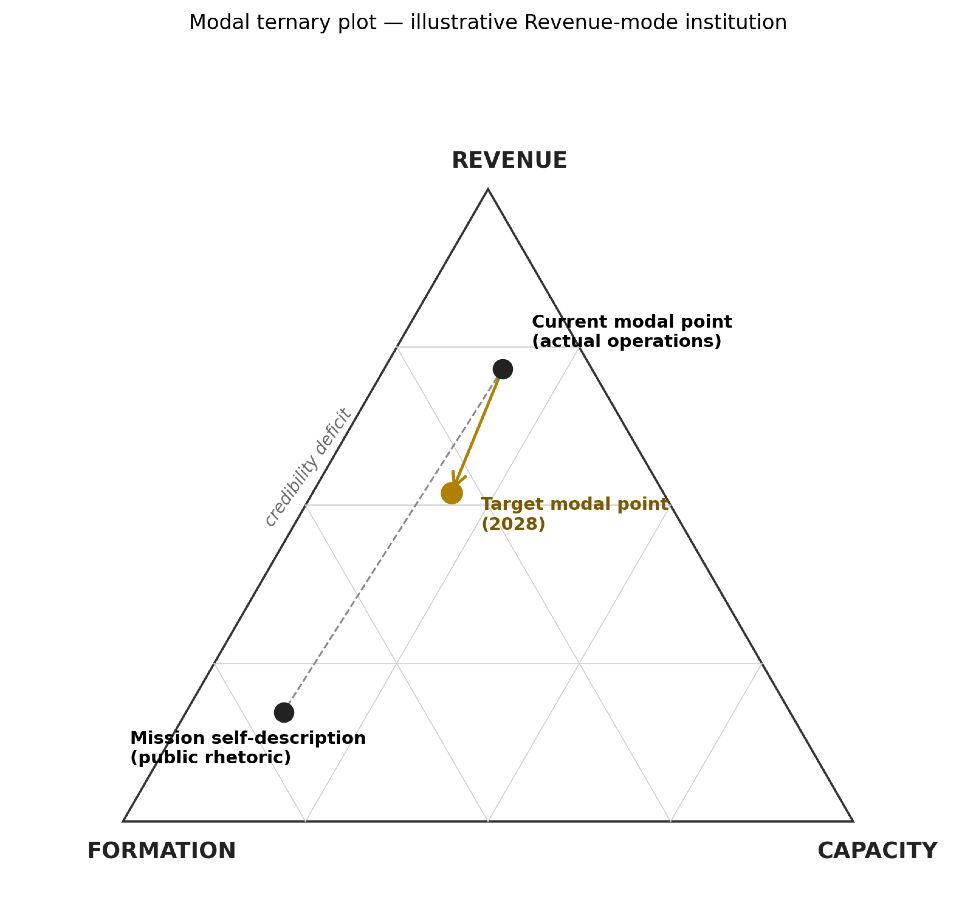
Figure 1. Modal ternary plot. The distance between current operations and mission self-description is the credibility deficit. The arrow indicates the institution’s 2028 target.
The figure’s value lies in showing the distance between two points: the current modal point, where the institution’s operations actually sit based on the audit, and the mission self-description, where the institution’s public statements place it. A typical Revenue-mode institution will find the two far apart — mission statements gravitate toward the Formation vertex while actual operations cluster near the Revenue corner. That distance is the credibility deficit, made visible. A third point, the target modal point for 2028, represents the rebalancing the institution intends to undertake. The architecture does not dictate where this point should sit; it requires only that the relationship between current operations, mission rhetoric, and target be named, planned, and reported against.
The placements on the ternary plot are produced by an activity-level audit conducted in advance of the figure. For each internationalization activity, four questions are answered: what is the primary funding source (public subsidy, domestic tuition cross-subsidy, international tuition, competitive grant, donor or ODA contribution, philanthropic gift); what evidence is currently collected (volume metrics, outcome metrics, both, or neither); who is the primary audience for reporting (board, finance ministry, accreditor, faculty governance, partner institution, public, none specified); and is the outcome claim attached to this activity defensible on its own evidence base under external scrutiny (yes, partial, no). The aggregated answers produce the modal coordinates and, more usefully, identify the specific activities at which the credibility deficit is concentrated. The figure is the summary; the audit is the substance. Boards that move directly to the figure without the underlying audit are repeating, in a more visually compact form, the synthesized reporting the architecture is intended to displace.
8.4 One Report, Three Angles
The architecture does not require multiplying reporting documents. It requires structuring the existing single annual report so that the three configurations are visible within it: an opening framing that addresses all three together (mission, modal distribution, headline developments); three configuration-specific sections proceeding through the metrics in the table below; and a closing portfolio commentary that returns to the integrated frame and names any modal rebalancing the year ahead will require.
| Configuration | Typical Activities | How it should be reported |
|---|---|---|
| Revenue | International tuition recruitment; English-medium master’s programmes; branch and overseas campuses; transnational education delivered in-country; rankings management; post-study work pipelines. | Fee income by source country and programme; new-entrant enrolment volumes; revenue concentration by sending country; graduate employment outcomes; financial-sustainability ratios; modelled exposure to a 20–40 per cent contraction in any single sending market. |
| Formation | Internationalization at home; virtual exchange and Collaborative Online International Learning (COIL); intercultural curriculum integration by discipline; study abroad with structured assessment; faculty development for intercultural teaching. | Intercultural-competence assessments using validated instruments (Deardorff framework and successors); pedagogical-design feature compliance for each Formation activity; participation rates across the full student body; graduate dispositional surveys; disciplinary translation of formation outcomes documented unit by unit. |
| Capacity | Faculty doctoral training abroad with documented return commitments; joint research with capacity-transfer terms; donor- and ODA-funded capacity programmes; regional research consortia; equipment-access partnerships; doctoral pipelines for staff renewal. | Co-authored publications by discipline, paired across globally indexed and regionally indexed venues; doctoral-return rates with placement tracking and downstream faculty-retention indicators; faculty career trajectories within the domestic system; alignment of partnership outputs with the host country’s stated research-priority frameworks; participation in South–South research consortia and grant-leadership share in both Northern-led and South–South funding; equipment-use logs and documented localization of methods and instrumentation into domestic programs; technology and methodology transfer documented over multi-year horizons. |
| Stewardship overlay | Mode declaration for every activity; bargain naming in cross-configuration partnerships; portfolio-level governance and quarterly review; designation of a Stewardship lead reporting to the Provost or VP equivalent. | A single annual internationalization report with portfolio framing followed by three configuration-specific sections; explicit cross-configuration activity register with named bargains; portfolio-level commentary on modal balance and year-ahead posture; differentiated audience versions derived from the master document. |
The architecture’s principal output is not a new operating model. It is a credible institutional voice. Under stewardship, the same university that previously claimed undifferentiated global citizenship outcomes can now say, accurately: we operate three lines of international engagement; here is what each contributes; here is the evidence we have for each; here is what we cannot yet show, and here is what we are doing to address that gap. This is the kind of voice that boards, regulators, ministries, and journalists currently expect from finance, research compliance, and student safety. It is the kind of voice that internationalization has not yet developed at scale.
Section 9
9. Conclusion
The internationalization of higher education in 2026 is not in crisis because it produces no value. It is in crisis because it has lost the ability to describe accurately the value it produces.
Each of the three configurations is substantial and largely defensible on its own terms. Revenue underwrites the financing of liberal-market higher education. Formation, where properly designed and assessed, produces pedagogical outcomes that justify its place in the curriculum. Capacity has shaped the research base of countries that are now major contributors to global science. None of the three is the same as either of the others, and no real institution operates only one of them. The credibility problem is not just that the configurations have been conflated, but that the hybrid reality of most institutions has never had a usable governance framework, and that the public-communications apparatus of the field has been engineered, with no individual’s bad intent, to keep that hybrid reality undescribed.
The Stewardship Architecture is the framework. It requires no capital expenditure, no legislative change, and no abandonment of any existing program. What it requires is the recognition that the descriptive accountability the sector did not produce for itself will, if not produced now, be produced for it — by regulators, by migration ministries, and by the political environment — on terms the institution will not have set. The single most consequential adoption decision available to leadership in 2026 is to commission a Stewardship Audit of the existing internationalization portfolio — identifying which activities operate principally in which mode, where evidence-base gaps sit, and which cross-configuration partnerships have unnamed bargains — and to formally adopt portfolio reporting that presents the three configurations side by side.
Return to the globe. The arcs are still there. The seven million students, the tens of thousands of academic relationships, the hundred billion dollars in tuition flow, the doctoral pipelines and research consortia and curriculum redesigns: all of it is real and most of it is good. The work deserves a description that does not crumble under scrutiny. The institutions that adopt the Stewardship Architecture in the 2026–2028 window will hold a credibility advantage that those that do not will struggle to recover. The credibility deficit is current. The architecture to address it is now available. The decision is whether to adopt it.
Simulate the Solution
To help universities apply the Stewardship Architecture framework presented in this paper, we have developed two specialized digital instruments. Select the starting point that aligns with your current strategic and governance goals:
🔍 Audit Simulator (Quick Scan)
A rapid, comprehensive scan of your university’s current activity inventory. Browse and select from 155 master strategies to instantly map your rough portfolio skew and identify potential structural misalignments.
⚖️ Stewardship Classifier (Diagnostic)
A rigorous, three-step analytical wizard to weight selected strategic archetypes by operational intensity and context, producing a formal, board-defensible diagnostic assessment of your portfolio.
Full Bibliography
References
Abramson, L. (2010, July 6). Michigan State to close Dubai campus. NPR.
Altbach, P. G., Reisberg, L., & Rumbley, L. E. (2009). Trends in global higher education: Tracking an academic revolution. UNESCO.
ApplyBoard. (2025). Australia’s caps refocus student demand toward university programs. ApplyBoard Insights.
Bedenlier, S., & Zawacki-Richter, O. (2015). Internationalization of higher education and the impacts on academic faculty members. Research in Comparative and International Education, 10(2), 185–201.
Beelen, J., & Jones, E. (2015). Redefining internationalisation at home. In A. Curaj, L. Matei, R. Pricopie, J. Salmi, & P. Scott (Eds.), The European higher education area: Between critical reflections and future policies (pp. 59–72). Springer.
Boundless Immigration. (2025). International students studying in the United States: Trends and impacts 2025. Boundless.
British Council. (2024). Landscape of in-country funding options for students from Bangladesh, India and Pakistan to pursue higher education overseas. British Council.
Buckner, E., & Stein, S. (2020). What counts as internationalization? Deconstructing the internationalization imperative. Journal of Studies in International Education, 24(2), 151–166.
CBC News. (2025, November 6). University of Calgary faces $34.7 million shortfall amid more international student cuts. CBC News.
Childress, L. K. (2010). The twenty-first century university: Developing faculty engagement in internationalization. Peter Lang.
Deardorff, D. K. (2006). Identification and assessment of intercultural competence as a student outcome of internationalization. Journal of Studies in International Education, 10(3), 241–266.
Deardorff, D. K., & van Gaalen, A. (2012). Outcomes assessment in the internationalization of higher education. In D. K. Deardorff, H. de Wit, J. D. Heyl, & T. Adams (Eds.), The SAGE handbook of international higher education (pp. 167–189). SAGE.
de Wit, H., Hunter, F., Howard, L., & Egron-Polak, E. (2015). Internationalisation of higher education. European Parliament, Directorate-General for Internal Policies.
de Wit, H., Jaramillo, I. C., Gacel-Ávila, J., & Knight, J. (Eds.) (2005). Higher education in Latin America: The international dimension. World Bank.
Eftekhari, P., Yousefzadeh, S., & Coelen, R. J. (2025). Internationalization of the curriculum at home (IoCaH): Why academic disciplines matter. Journal of Studies in International Education, 29(4).
Gacel-Ávila, J. (2007). The process of internationalization of Latin American higher education. Journal of Studies in International Education, 11(3-4), 400–409.
Gallup. (2024). U.S. confidence in higher education now closely divided. Gallup News, 8 July.
Gallup-Lumina. (2025). State of higher education 2025. Gallup, in partnership with the Lumina Foundation.
Granato, S., & Schnepf, S. V. (2024). Why are lower socioeconomic background students underrepresented in Erasmus? A focus on the selection into mobility and degree course organization. Studies in Higher Education, 49(4), 638–652.
Gutović, V., Bouckaert, M., Xia, T., Quinteiro Goris, J. A., Baroni Boces, G., Sears, M. D., Peterson, M. S., & Osei, E. (2026). Higher education global trends report: Towards inclusive, equitable and quality higher education in an internationally mobile landscape. UNESCO International Institute for Higher Education in Latin America and the Caribbean.
Harrison, N. (2015). Practice, problems and power in ‘internationalisation at home’: Critical reflections on recent research evidence. Teaching in Higher Education, 20(4), 412–430.
Harrison, N., & Peacock, N. (2010). Cultural distance, mindfulness and passive xenophobia: Using Integrated Threat Theory to explore home higher education students’ perspectives on ‘internationalisation at home’. British Educational Research Journal, 36(6), 877–902.
Hazelkorn, E. (2015). Rankings and the reshaping of higher education: The battle for world-class excellence (2nd ed.). Palgrave Macmillan.
Heitor, M., Horta, H., & Salmi, J. (Eds.) (2016). Trends and challenges in science and higher education: Building capacity in Latin America. Springer.
Helms, R. M., Brajkovic, L., & Struthers, B. (2017). Mapping internationalization on U.S. campuses: 2017 edition. American Council on Education.
Heriot-Watt University. (2025). Celebrating our 20th anniversary: Heriot-Watt University Dubai. Heriot-Watt University.
Higher Education Statistics Agency (HESA). (2024). Higher education provider data: Finance 2022/23. Jisc.
House of Commons Library. (2024). International students in UK higher education (Briefing Paper CBP-7976). UK Parliament.
Huang, F., Crăciun, D., & de Wit, H. (2022). Internationalization of higher education in a post-pandemic world: Challenges and responses. Higher Education Quarterly, 76(2), 203–207.
Hudzik, J. K. (2011). Comprehensive internationalization: From concept to action. NAFSA: Association of International Educators.
ICEF Monitor. (2026). New international student permit approvals for Canada fell below COVID levels in 2025. ICEF Monitor.
Immigration, Refugees and Citizenship Canada (IRCC). (2024, January 22). Canada to stabilize growth and decrease number of new international student permits issued to approximately 360,000 for 2024. Government of Canada.
Immigration, Refugees and Citizenship Canada (IRCC). (2025). 2025 provincial and territorial allocations under the international student cap. Government of Canada.
Jon, J.-E. (2013). Realizing internationalization at home in Korean higher education: Promoting domestic students’ interaction with international students and intercultural competence. Journal of Studies in International Education, 17(4), 455–470.
Knight, J. (2003). Updating the definition of internationalization. International Higher Education, (33), 2–3.
Lane, J. E., & Kinser, K. (2014). International branch campuses: Closure of cases and lessons learned. International Higher Education, (78), 12–14.
Marginson, S. (2007). The public/private divide in higher education: A global revision. Higher Education, 53(3), 307–333.
Marginson, S. (2026). Global higher education in times of upheaval: On common goods, geopolitics and decolonisation. Bloomsbury Academic.
Marginson, S., Yang, L., & Brotherhood, T. (2025). Making the world a better place? English higher education and global public good. Higher Education, 89(1), 99–127.
Mohamedbhai, G. (2014). Improving the quality of higher education in sub-Saharan Africa: A regional approach. International Higher Education, (76), 9–11.
Mulvey, B. (2025). Towards a more just global regime of international student mobility. Ethics and Education. Advance online publication.
Nicol, D. (2025). International graduates and the new employability challenge. Higher Education Policy Institute (HEPI).
OECD. (2025). OECD Science, Technology and Innovation Outlook 2025. OECD Publishing.
Office for Students. (2025a). Financial sustainability of higher education providers in England: May 2025. Office for Students.
Office for Students. (2025b). Financial sustainability of higher education providers in England: November 2025 update. Office for Students.
Pew Research Center. (2024). Americans’ deepening mistrust of institutions. The Pew Charitable Trusts, Trend Magazine.
Ramaswamy, M., Marciniuk, D. D., Csonka, V., Colò, L., & Saso, L. (2021). Reimagining internationalization in higher education through the United Nations Sustainable Development Goals for the betterment of society. Journal of Studies in International Education, 25(4), 388–406.
Slaughter, S., & Rhoades, G. (2004). Academic capitalism and the new economy: Markets, state, and higher education. Johns Hopkins University Press.
Societās Partnerships. (2024a). The global scholarship: A strategic funding analysis of the global scholarship ecosystem. Societās Partnerships, Panama City. Available at societaspartnership.com/reports.
Societās Partnerships. (2024b). Decolonizing research: Data colonialism, federated architectures, and South–South collaboration. Societās Partnerships, Panama City. Available at societaspartnership.com/reports.
Societās Partnerships. (2025). Multipolar academic world: China’s ascent and the geopolitical responses across the Five Eyes, the European Union, and the major non-Western academic systems. Societās Partnerships, Panama City. Available at societaspartnership.com/reports.
Stein, S. (2021). Critical internationalization studies at an impasse: Making space for complexity, uncertainty, and complicity in a time of global challenges. Studies in Higher Education, 46(9), 1771–1784.
Stohl, M. (2007). We have met the enemy and he is us: The role of the faculty in the internationalization of higher education in the coming decade. Journal of Studies in International Education, 11(3-4), 359–372.
Sutton, S. B., & Obst, D. (Eds.) (2011). Developing strategic international partnerships: Models for initiating and sustaining innovative institutional linkages. Institute of International Education.
Tamrat, W., & Teferra, D. (2018). Internationalization of Ethiopian higher education institutions: Manifestations of a nascent system. Journal of Studies in International Education, 22(5), 434–453.
Teferra, D. (2014). Charting African higher education: Perspectives at a glance. International Journal of African Higher Education, 1(1), 9–21.
Teferra, D., & Knight, J. (Eds.) (2008). Higher education in Africa: The international dimension. Center for International Higher Education, Boston College, and Association of African Universities.
The National. (2010, July 5). Michigan State University shuts most of its Dubai campus. The National (Abu Dhabi).
Tony Blair Institute for Global Change. (2025). Data decoded: UK higher education, immigration and financial sustainability. Tony Blair Institute.
UK Home Office. (2024). Immigration system statistics, year ending June 2024. Home Office.
UNESCO Institute for Statistics (UIS). (2024). International students in tertiary education. UIS data portal.
Volet, S. E., & Ang, G. (2012). Culturally mixed groups on international campuses: An opportunity for inter-cultural learning. Higher Education Research & Development, 31(1), 21–37.
Wilkins, S., & Juusola, K. (2018). The benefits and drawbacks of transnational higher education: Myths and realities. Australian Universities’ Review, 60(2), 68–76.
Yale University. (2026, April). Report of the Committee on Trust in Higher Education. Office of the President, Yale University.
Yonezawa, A., & Yamamoto, B. A. (2024). Internationalization of higher education in Asia: Faculty study abroad experiences in leading universities in Southeast Asia and beyond. In Theorizing the internationalization of higher education in Asia. Springer.
societaspartnership.com
Two Internationalizations · May 2026